I work as a professor in the Department of Sociology at The Ohio State University (OSU). I am a faculty affiliate of the Institute for Population Research and core faculty in the Translational Data Analytics Institute, both at OSU. I am affiliated with the Department of Statistics at the University of Washington and the School of Public Health at the University of the Witwatersrand.
My work has four main strands, most of them with open-source software:
- Cause of death. Methods for verbal autopsy, including the InSilicoVA algorithm and the openVA tools, which are moving into routine use in national civil registration and vital statistics systems, and new AI methods that also read the verbal autopsy narrative.
- Reference Data Archive. I led the creation of the Reference Data Archive, a global archive of reference deaths for training and validating cause-of-death methods, hosted by WHO since December 2025 at data.who.int/rda.
- Mortality models. Low-dimensional models of age-specific mortality: SVD-Comp, a version of which has been part of UN World Population Prospects since the 2022 revision, and its successor MDMx, which models many populations through time in a single framework to smooth, estimate, and forecast mortality. Try the MDMx app; an interactive tutorial explains the SVD, SVD-Comp, and how MDMx extends them.
- Small-area estimation. Space-time estimates of child mortality from household surveys, a project I started at the University of Washington that Jon Wakefield now leads, including subnational estimates for UNICEF.
Leadership and service:
- WHO. Member of the Verbal Autopsy Reference Group since it formed in 2013, including the task group updating the WHO standard verbal autopsy instrument, and of the Technical Advisory Group on Health Statistics.
- Networks. Lead the openVA Team; contributed to founding and growing the INDEPTH Network of health and demographic surveillance sites (Scientific Advisory Committee, 2010-2018); long-term contributor to the Agincourt site in South Africa.
- Profession. Elected member of the IUSSP Council (2018-2021); deputy editor of Demography (2010-2012).
- Funding and mentoring. Principal investigator on NIH and Gates Foundation grants; chaired/primary advisor of nine completed PhD committees.
Updates
2026-10
Our new working paper Multimodal Artificial Intelligence for Cause-of-Death Assignment from Verbal Autopsy Records: A National Benchmark Study in South Africa, led by Yue Chu, is now on medRxiv. Fine-tuned language models reading the free-text verbal autopsy narrative alone improved substantially on InSilicoVA and matched models using the structured questionnaire, and combining the two improved individual-level cause-of-death assignment further.
Our paper A Multimodal Benchmark for Evaluating Cause-of-Death Inference Using Child Health and Mortality Data has been accepted in the Evaluations & Datasets Track at NeurIPS 2026. It builds a cause-of-death benchmark from CHAMPS data and evaluates zero-shot large language models against supervised baselines.
2026-04
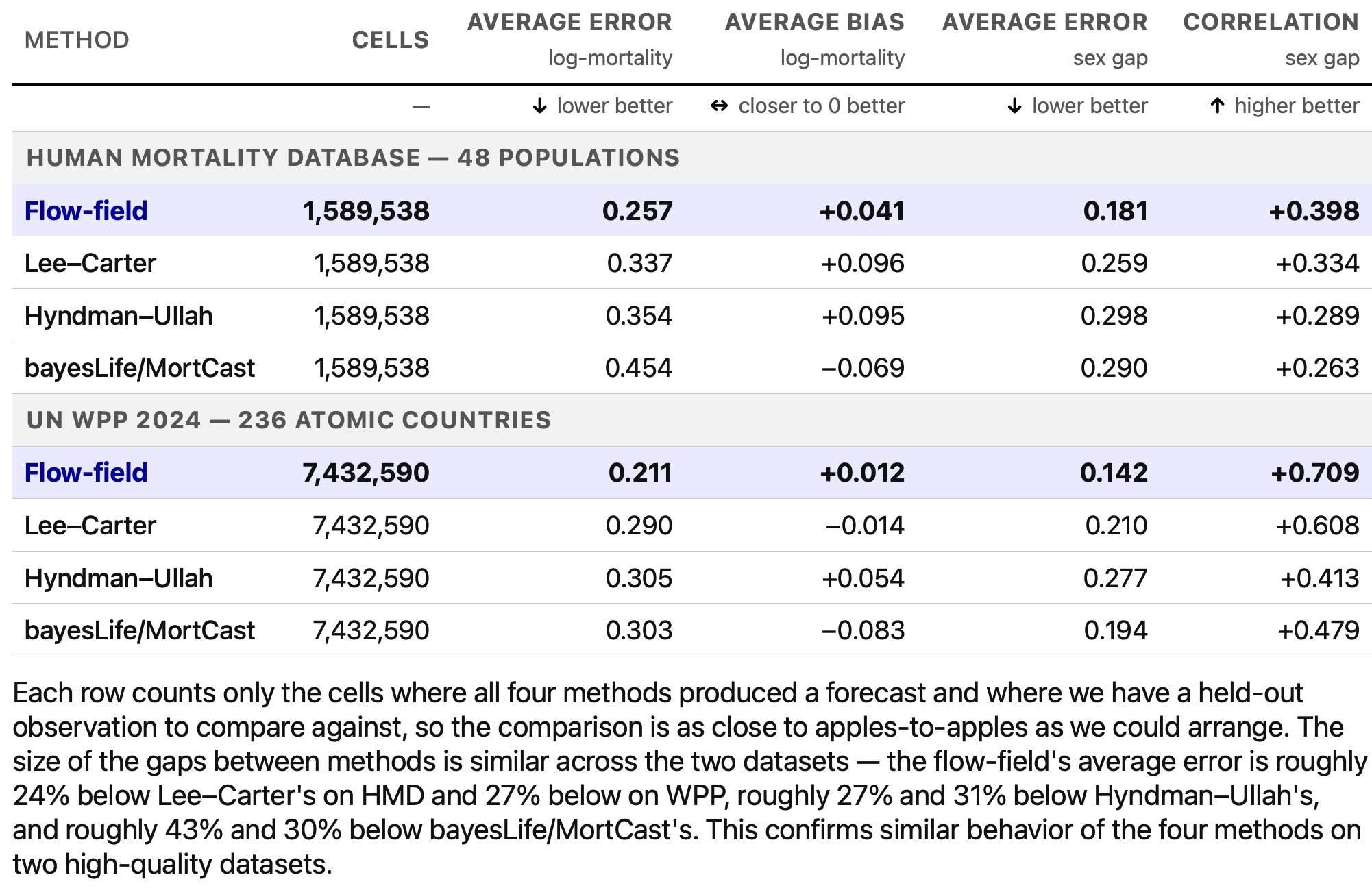
Preliminary results from my flow-field mortality forecasting work: across about nine million held-out forecasts from the Human Mortality Database and World Population Prospects 2024, the flow-field method had the lowest error of the four methods tested, with average error roughly a quarter below Lee–Carter's.
2026-03
In my dissertation, I built a simple set of model life tables based on mortality data from the INDEPTH Network sites. The latest iteration of this idea is written up in this working paper: Multi-dimensional Mortality (MDMx): Sex-Age-Specific Model Life Tables, Fitting, Prediction from Summary Mortality Indicators, and Forecasting.
Almost immediately after finishing the working paper above, I realized I could do the mortality forecasting in a completely different and perhaps better way, written up in this working paper: Mortality Forecasting as a Flow Field in Tucker Decomposition Space.
There is a Shiny app to go along with the two working papers that implements and demonstrates all the methods: MDMx.
2025-12
With a team including Doris Ma Fat, Philippe Boucher, and Dan-George Vasilache at the Data, Digital Health, Analytics and AI Department (DDA) of the WHO; Kobus Herbst and Brendan Gilbert at AHRI; and Norman Goco and David Plotner at RTI; the openVA Team has just completed creation of the Reference Data Archive at WHO: https://data.who.int/rda.
Older updates are on the News page.